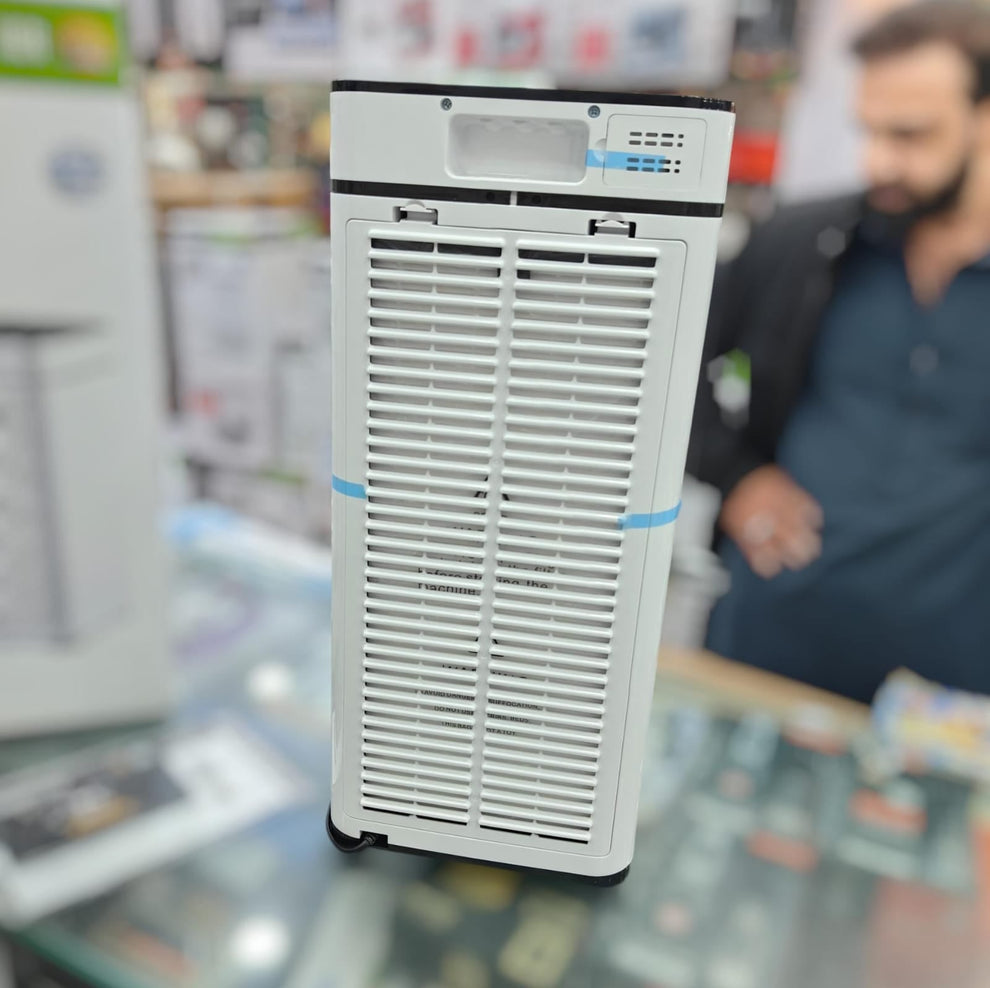
Geepas air purifier GAP 63102P
GAP63102P
PRODUCT FEATURES:
4 Stage filtration
Pre-Filter captures large dust and hair particles
True HEPA fi ter H13 captures99.97% of particles
downto 0.3 microns
Active Carb on Filter removes odors, smoke, VOCs,
and harmful gases
Built-in lonizer for enh anced air purification
Easy ele ctronic touch control
With timer function:1/2/4/8h
4 speed settings
With three color d isplay function for air quality
Filterrep lacement reminder
Child-lock function
CADR:330m'/h
Effective area: 45m'
Max noise:66dB
Ratings: AC220-240V 50Hz 60W
| Feature | Details |
| Coverage Area | Up to 45 $m^2$ (approx. 484 sq. ft.) |
| CADR | 330 $m^3/h$ (Clean Air Delivery Rate) |
| Fan Speeds | 4 Settings (Low, Med, High, Turbo) |
| Power Consumption | 60W |
| Noise Level | Max 66 dB |
Core Features
-
4-Stage Medical Grade Filtration: * Pre-Filter: Captures visible particles like lint and pet hair.1
-
H13 True HEPA Filter: Traps 99.97% of microscopic pollutants, including 2$PM_{2.5}$, pollen, and allergens.3
-
Activated Carbon Filter: Absorbs toxic gases, VOCs, and strong household odors.
-
Ionizer: Releases negative ions to neutralize airborne bacteria and freshen the air.4
-
-
Intelligent Air Quality Monitoring: Features a high-precision dust sensor and a 3-color LED display (typically Green, Yellow, Red) that visually communicates the current air quality in the room.5
-
Expanded Controls: Unlike the 63100, this model usually features 4 fan speed settings, giving you more control over airflow during high-pollution events.
-
Smart Timer & Safety: Includes a programmable timer (1, 2, 4, or 8 hours) and a Child Lock function to prevent curious hands from changing settings.6
-
Automatic Mode: The device can detect pollution levels and automatically increase its fan speed to clear the air faster, then drop back to a quiet mode once the air is clean.
How it compares to the GAP63101P
While the GAP63101P and GAP63102P share the same CADR (330 $m^3/h$), the GAP63102P is optimized for slightly larger square footage (45 $m^2$ vs 40 $m^2$). It is often chosen for its larger chassis which allows for slightly better air intake efficiency in open-plan rooms.
Since you've looked at the 100, 101, and 102 models, would you like me to create a side-by-side comparison table to help you decide which one is the best value for your specific room size?